


Ukrainian President Volodymyr Zelensky has said that while Ukraine is willing to halt attacks on Russia’s energy infrastructure, Moscow has continued to strike his country’s energy sites despite US President Donald Trump’s announcement that the warring countries had agreed to cease such attacks.
Speaking at the Warsaw Security Forum in Poland, Mr Zelensky said Ukraine had been “horribly surprised” that Moscow struck a power plant in the north-eastern city of Kharkiv, as well as a gas production facility and a civilian gas station hours after Mr Trump announced the purported “energy ceasefire” in the four-and-a-half-year-old war.
Later on Monday, during an interview on Fox News Channel’s America’s Newsroom, Mr Zelenksy said his government had refrained from striking Russian energy sites since Mr Trump’s announcement on Sunday, and was ready to honour an energy ceasefire as “a good first step” towards closing the war.

But, he said, “I’m not sure that (Russian President Vladimir) Putin is ready.”
“Even after yesterday’s messages from (Trump)… Putin attacked our gas infrastructure,” Mr Zelensky said.
“When we speak about energy ceasefire, it means only one thing: that they don’t attack our energy infrastructure and we don’t respond on their energy infrastructure.”
Speaking to reporters at the White House, Mr Trump insisted that an energy ceasefire was in place.
He said: “Well, they agreed. Because I said, ‘You agree’. That’s why they agreed, because I said they agree.”
When pressed about the attacks by Russia, Mr Trump said, “Well, I’d have to look at it and see, because there’s been violations on both sides.”
Mr Trump’s brief social media post on Sunday offered few details but said the energy ceasefire took effect immediately, adding: “Do not break it!”
We never communicate what we will do next in our operations. Last night, we did not attack any energy facilities on the territory of Russia because President Trump said that there would be an energy ceasefire between Ukraine and Russia. We did not attack, while Russia attacked… pic.twitter.com/PNGtw2VwEZ
— Volodymyr Zelenskyy / Володимир Зеленський (@ZelenskyyUa) October 12, 2026
On Monday, Kremlin spokesman Dmitry Peskov would not say whether Russia had agreed to such a ceasefire, saying only: “Contacts are ongoing.”
Mr Trump previously announced a similar agreement on ceasing energy strikes that did not come to fruition.
In a social media post on September 14, he said both countries had agreed “not to hit” each other’s energy infrastructure, but offered no details on that proposal either.
Russia has used attacks on energy facilities to deny Ukrainian civilians power, heat and running water during the war, hoping to wear down public resistance to Moscow’s full-scale invasion.
Ukrainian officials describe the strategy as “weaponising winter”, and fear Russia could ramp up such attacks as cold weather approaches.
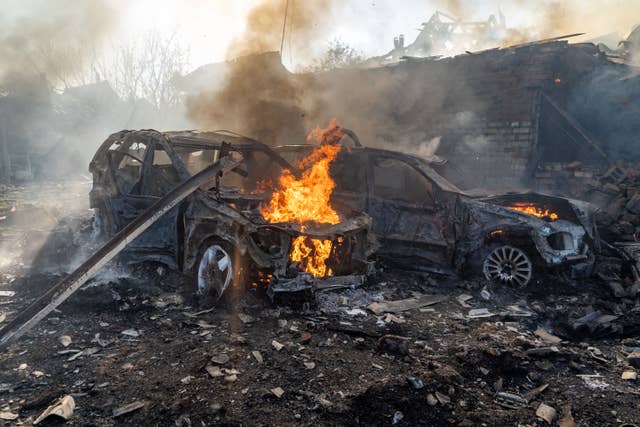
Meanwhile, Ukraine has levelled strikes against Russian energy sites such as oil refineries, sometimes deep within Russian territory, prompting Mr Trump to blame Mr Zelensky for high diesel prices on world markets.
On Friday, Mr Trump struck a deal with Mr Putin to import Russian diesel in an attempt to address high fuel prices just weeks ahead of US midterm elections.
Speaking on Fox News on Monday, Mr Zelensky pushed back on Mr Trump’s claims that Ukrainian strikes in Russia were driving up fuel prices, saying: “Everybody understands that the prices on diesel (don’t) depend on our attacks on diesel in Russia. Everybody understands that it depends on the blocking (of the) Strait of Hormuz.”
The European Union’s top diplomat on Monday welcomed the prospect of a pause in energy strikes in Ukraine, particularly as winter approaches, but said she sees no sign that Russia would be willing to respect it.
“We haven’t yet seen that also Russia will stick to it,” EU foreign policy chief Kaja Kallas said at a meeting of the bloc’s foreign ministers in Luxembourg.
“Personally, I would also welcome that the ceasefire would include people not being killed, not only energy.”
Today, we will adopt nearly 1,600 new sanctions listings targeting Russia’s military-industrial complex.
This will be the single largest expansion of our sanctions list since Russia started its war.
We also welcome the energy ceasefire, when it holds.But we haven't seen yet… pic.twitter.com/cCJ6cYwZDA
— Kaja Kallas (@kajakallas) October 12, 2026
Mr Trump’s deal with Mr Putin to purchase diesel from Russia dismayed officials in the US, Ukraine and around Europe.
A bipartisan group of six senators, including four Republicans, called on the Trump administration on Sunday to “immediately reverse course” on the deal, saying the US should “not provide Putin with a financial lifeline” while Russia is killing Ukrainian civilians.
Estonian foreign minister Margus Tsahkna told reporters in Luxembourg on Monday that he does not believe the deal “is actually going to change anything” in terms of fuel prices, and that it is “much more connected to the domestic situation in the US”.
Ms Kallas, the EU’s foreign policy chief, also pushed back on Mr Trump’s comments on Saturday that it was time for Ukraine to get a new president and that Mr Zelensky has not done enough to end the war.
She said that now is not the time to hold elections in Ukraine, at least not without a ceasefire.
On Monday, Mr Zelensky said holding elections in Ukraine was impossible during war time, especially with new Russian tactics involving attacks during both the day and night.
“Under such circumstances, it’s impossible to hold elections,” he said, but added that he would be ready to work towards doing so if Ukraine secured a full ceasefire lasting at least 60 days.
In response, Kremlin spokesman Mr Peskov said in a statement that in case of a Ukrainian election, Mr Putin would be ready to halt strikes on Ukraine “specifically on election day”, and that Kyiv only wanted a 60-day ceasefire “to gather their strength, heal their wounds, and continue the war”.
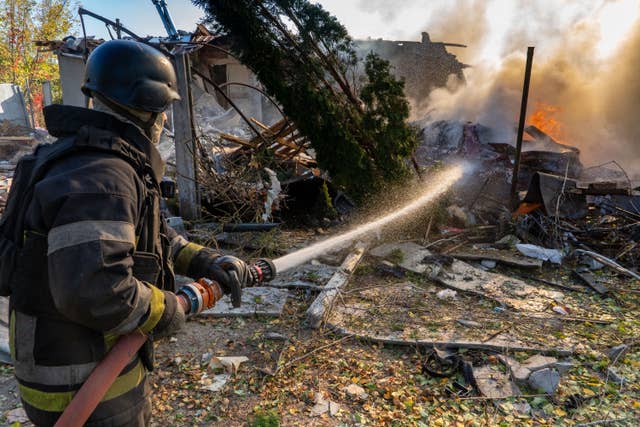
One woman died and at least five other people were injured after a Russian drone hit a 25-storey residential building in Kyiv’s Darnytskyi district on Monday night, the city’s military administration said. While falling debris from Russian attacks sparked a fire in a private residential building in the same area.
Two people were also injured in daytime strikes on Kyiv on Monday, according to the city’s military administration.
Debris also fell in an open area near private residential buildings in the Solomianskyi district, and on a warehouse building in the Darnytskyi district, with emergency services dispatched to the scene.
A Russian drone attack on the village of Pisochyn in the Kharkiv district on Sunday evening killed three people and injured nine others, including children, according to the Kharkiv regional prosecutor’s office.
Investigators said the attack occurred at approximately 7.25pm, striking a densely populated area near apartment buildings and food shops and sparking a fire.
Ukrainian air defence forces shot down or suppressed 89 of 121 Russian drones overnight on Monday, Ukraine’s air force said in a Telegram post.
— Rapid Response 47 (@RapidResponse47) October 11, 2026
The attack involved one Kh-59 guided air-to-surface missile and 121 drones, including 76 jet-powered Shahed-type drones, the statement said.
Strikes were recorded at 15 locations in Ukraine, while debris from downed drones fell at four locations.
The Russian defence ministry said on Monday that its air defences intercepted 151 Ukrainian drones over Russian regions as well as the illegally annexed Crimea and the waters of the Black Sea overnight.
In a separate statement, the ministry said its forces carried out drone strikes on Ukraine’s unspecified port infrastructure and a bulk carrier heading to Ukraine’s port city of Odesa with military cargo on board overnight.


Share